# -*- coding: utf-8 -*-
"""
ATT-A-IPTW主分析(多重插补+全流程可视化融合版-修复列名匹配)
修复问题:KeyError: 'imaging_response'(结局变量列名不匹配)
"""

# ======================== 1. 库导入与MAC环境配置 ========================
import pandas as pd
import numpy as np
import matplotlib.pyplot as plt
from scipy import stats
from sklearn.linear_model import LogisticRegression, BayesianRidge
from sklearn.preprocessing import StandardScaler
from sklearn.metrics import roc_auc_score
import warnings
import os
from scipy.stats import gaussian_kde
import math
from IPython.display import display, Image
from sklearn.experimental import enable_iterative_imputer
from sklearn.impute import IterativeImputer
warnings.filterwarnings('ignore')

# MAC中文显示配置
def set_mac_chinese_font():
    plt.rcParams['font.sans-serif'] = ['PingFang SC', 'Songti SC', 'DejaVu Sans']
    plt.rcParams['axes.unicode_minus'] = False
    plt.rcParams['figure.facecolor'] = 'white'
    plt.rcParams['figure.dpi'] = 120
    plt.rcParams['font.size'] = 11
    print("✅ MAC中文环境配置完成!")
set_mac_chinese_font()

# 路径配置(请根据你的MAC路径修改)
DATA_PATH = "/Users/wangguotao/Downloads/ISAR/Doctor/数据分析总表.xlsx"
OUTPUT_DIR = "/Users/wangguotao/Downloads/ISAR/Doctor/ATT_IPTW_融合分析结果/"
if not os.path.exists(OUTPUT_DIR):
    os.makedirs(OUTPUT_DIR, mode=0o755)
    print(f"✅ 自动创建结果目录:{OUTPUT_DIR}")

# 变量映射(外科=1处理组,内镜=0对照组)
VARIABLE_MAPPING = {
    '囊肿位置(1:胰头颈、2:胰体尾4:胰周)': 'lesion_location',
    '囊肿最大径mm': 'lesion_max_diameter_mm',
    '包裹性坏死': 'walled_necrosis',
    '改良CTSI评分': 'modified_ctsi_score',
    '年龄': 'age_years',
    'BMI': 'bmi',
    '性别(1:男、2:女)': 'gender',
    'APACHE II评分': 'apache2',
    '重症胰腺炎(1:有2:无)': 'severe_pancreatitis',
    '病因(1、酒精性2、高甘油三脂血症性3、胆源性4、急性胰腺炎5、慢性胰腺炎6、胰腺手术7、胰腺外伤8、自身免疫性9、特发性)': 'etiology',
    '糖尿病(1、是2、否)': 'comorbidity_diabetes',
    '高血压(1、是2、否)': 'comorbidity_hypertension',
    '高脂血症(1、是2、否)': 'hyperlipid',
    '腹腔积液(1、是2、否)': 'ascites',
    '门脉高压1:是2:否': 'portal_htn',
    '胆囊结石(1、有2、无)': 'gallstone',
    '术前白细胞': 'wbc_pre',
    '吸烟(1、是2、否)': 'smoking_history',
    '饮酒(1、是2、否)': 'drinking_history',
    '影像学缓解(1:是2:否)': 'imaging_response',  # 预设列名(可能不匹配)
    '手术方式(1:内镜2:外科)': 'treatment'
}

# 固定协变量(用于PS模型)
FIXED_COVARIATES = ['lesion_max_diameter_mm', 'modified_ctsi_score',
                    'lesion_location', 'bmi', 'comorbidity_hypertension', 'walled_necrosis']
print(f"✅ 路径与变量配置完成,固定协变量:{FIXED_COVARIATES}")

# ======================== 2. 函数1:BMI多重插补(修复结局变量列名匹配) ========================
def multiple_imputation_bmi(n_impute=5):
    print("\n" + "="*60)
    print("1. BMI多重插补(生成5个完整数据集-修复列名匹配)")
    print("="*60)

    # 步骤1:读取原始数据并查看所有列名(关键:先确认Excel实际列名)
    try:
        df_raw = pd.read_excel(DATA_PATH, sheet_name=0, engine='openpyxl')
    except:
        df_raw = pd.read_excel(DATA_PATH, sheet_name=0, engine='xlrd')

    print(f"📊 原始Excel文件列名(共{len(df_raw.columns)}个):")
    for i, col in enumerate(df_raw.columns, 1):
        print(f"   {i:2d}. {col}")  # 打印所有列名,方便确认匹配关系

    # 步骤2:模糊匹配关键变量列名(解决列名不匹配问题)
    # 2.1 匹配“影像学缓解”(结局变量):包含“影像”和“缓解”关键词
    imaging_cols = [col for col in df_raw.columns if '影像' in str(col) and '缓解' in str(col)]
    if len(imaging_cols) == 0:
        # 若未匹配到,提示手动选择
        print(f"\n⚠️  未自动匹配到'影像学缓解'列,请从上述列名中选择(输入列名序号):")
        selected_idx = int(input("   输入'影像学缓解'列的序号:")) - 1
        imaging_col = df_raw.columns[selected_idx]
    else:
        imaging_col = imaging_cols[0]
        print(f"\n✅ 自动匹配'影像学缓解'列:{imaging_col} → 映射为'imaging_response'")

    # 2.2 匹配“手术方式”(处理变量):包含“手术”和“方式”关键词
    treatment_cols = [col for col in df_raw.columns if '手术' in str(col) and '方式' in str(col)]
    if len(treatment_cols) == 0:
        print(f"\n⚠️  未自动匹配到'手术方式'列,请从上述列名中选择(输入列名序号):")
        selected_idx = int(input("   输入'手术方式'列的序号:")) - 1
        treatment_col = df_raw.columns[selected_idx]
    else:
        treatment_col = treatment_cols[0]
        print(f"✅ 自动匹配'手术方式'列:{treatment_col} → 映射为'treatment'")

    # 2.3 匹配其他必需变量(BMI、囊肿最大径等)
    required_vars = {
        'BMI': 'bmi',
        '囊肿最大径': 'lesion_max_diameter_mm',
        '改良CTSI': 'modified_ctsi_score',
        '囊肿位置': 'lesion_location',
        '高血压': 'comorbidity_hypertension',
        '包裹性坏死': 'walled_necrosis'
    }

    # 构建实际列名映射(替换原VARIABLE_MAPPING中不匹配的键)
    actual_mapping = {}
    for keyword, new_col in required_vars.items():
        matched_cols = [col for col in df_raw.columns if keyword in str(col)]
        if len(matched_cols) > 0:
            actual_mapping[matched_cols[0]] = new_col
            print(f"✅ 自动匹配'{keyword}'列:{matched_cols[0]} → 映射为'{new_col}'")
        else:
            print(f"⚠️  未找到'{keyword}'相关列,请确认Excel中列名是否包含该关键词!")

    # 添加已匹配的结局变量和处理变量
    actual_mapping[imaging_col] = 'imaging_response'
    actual_mapping[treatment_col] = 'treatment'

    # 步骤3:筛选有效变量并重命名
    impute_cols = list(actual_mapping.keys())  # 仅保留实际存在的列
    df_impute = df_raw[impute_cols].copy()
    df_impute.rename(columns=actual_mapping, inplace=True)  # 用实际映射重命名
    print(f"\n✅ 最终有效变量({len(df_impute.columns)}个):{list(df_impute.columns)}")

    # 步骤4:数据类型转换(处理字符串与缺失值)
    for col in df_impute.columns:
        if df_impute[col].dtype == 'object':
            df_impute[col] = df_impute[col].astype(str).str.replace(',', '').str.strip().replace('', np.nan)
        df_impute[col] = pd.to_numeric(df_impute[col], errors='coerce')

    # 步骤5:拆分完整数据与缺失数据(BMI)
    if 'bmi' not in df_impute.columns:
        raise Exception("❌ 未找到BMI列,请确认Excel中列名是否包含'BMI'关键词!")

    df_complete = df_impute[df_impute['bmi'].notna()].copy()  # 117例完整数据
    df_missing = df_impute[df_impute['bmi'].isna()].copy()    # 23例BMI缺失数据
    print(f"📊 数据拆分:完整数据{len(df_complete)}例,BMI缺失数据{len(df_missing)}例")

    # 步骤6:构建贝叶斯岭回归插补模型
    aux_vars = ['lesion_max_diameter_mm', 'modified_ctsi_score', 'lesion_location',
                'comorbidity_hypertension', 'walled_necrosis']
    aux_vars = [var for var in aux_vars if var in df_impute.columns]  # 仅保留存在的辅助变量

    if len(aux_vars) < 2:
        print(f"⚠️  辅助变量不足,补充'age_years'(若存在)")
        if 'age_years' in df_impute.columns:
            aux_vars.append('age_years')

    imputer = IterativeImputer(
        estimator=BayesianRidge(),
        max_iter=10,
        random_state=42,
        sample_posterior=True  # 抽样后验分布,生成不同插补值
    )
    imputer.fit(df_complete[aux_vars + ['bmi']].dropna())
    print(f"✅ 插补模型训练完成(BayesianRidge),使用辅助变量:{aux_vars}")

    # 步骤7:生成5个插补数据集
    imputed_datasets = []
    for i in range(n_impute):
        df_missing_imputed = df_missing.copy()
        imputed_bmi = imputer.transform(df_missing[aux_vars + ['bmi']])[:, -1]
        df_missing_imputed['bmi'] = imputed_bmi

        # 合并完整数据与插补数据
        df_full = pd.concat([df_complete, df_missing_imputed], ignore_index=True)

        # 基础编码(处理组/结局变量,确保值为1/2)
        if 'treatment' in df_full.columns:
            # 确保手术方式仅包含1(内镜)和2(外科)
            df_full = df_full[df_full['treatment'].isin([1, 2])].copy()
            df_full['treatment'] = df_full['treatment'].map({1: 0, 2: 1})  # 内镜=0,外科=1
        else:
            raise Exception("❌ 处理变量'treatment'缺失,无法继续分析!")

        if 'imaging_response' in df_full.columns:
            # 确保影像学缓解仅包含1(是)和2(否)
            df_full = df_full[df_full['imaging_response'].isin([1, 2])].copy()
            df_full['imaging_response'] = df_full['imaging_response'].map({1: 1, 2: 0})  # 缓解=1
        else:
            raise Exception("❌ 结局变量'imaging_response'缺失,无法继续分析!")

        # 保存数据集
        df_full.to_excel(f"{OUTPUT_DIR}1_插补数据集_{i+1}.xlsx", index=False, engine='openpyxl')
        imputed_datasets.append(df_full)
        print(f"✅ 生成插补数据集{i+1}:{len(df_full)}例(完整{len(df_complete)}例+插补{len(df_missing)}例)")

    # 步骤8:插补验证
    print(f"\n📋 插补验证:BMI分布一致性")
    observed_bmi = df_complete['bmi'].dropna()
    imputed_bmi_all = np.concatenate([df['bmi'].iloc[-len(df_missing):].values for df in imputed_datasets])

    validation_stats = pd.DataFrame({
        '指标': ['均值', '标准差', '最小值', '中位数', '最大值', '偏度'],
        '观察BMI(117例)': [
            round(observed_bmi.mean(), 2), round(observed_bmi.std(), 2),
            round(observed_bmi.min(), 2), round(observed_bmi.median(), 2),
            round(observed_bmi.max(), 2), round(stats.skew(observed_bmi), 3)
        ],
        '插补BMI(23×5=115例)': [
            round(imputed_bmi_all.mean(), 2), round(imputed_bmi_all.std(), 2),
            round(imputed_bmi_all.min(), 2), round(np.median(imputed_bmi_all), 2),
            round(imputed_bmi_all.max(), 2), round(stats.skew(imputed_bmi_all), 3)
        ]
    })
    display(validation_stats)

    # 数据集间变异验证
    between_impute_stats = pd.DataFrame({
        f'数据集{i+1}BMI均值': [round(df['bmi'].mean(), 2) for df in imputed_datasets],
        f'数据集{i+1}BMI标准差': [round(df['bmi'].std(), 2) for df in imputed_datasets]
    }, index=[1,2,3,4,5])
    print(f"\n📋 插补不确定性验证:5个数据集BMI变异")
    display(between_impute_stats)
    print(f"   • 数据集间BMI均值变异:{round(between_impute_stats.iloc[:,0].std(), 3)}(越小越稳定)")

    # 保存验证结果
    with pd.ExcelWriter(f"{OUTPUT_DIR}1_插补验证结果.xlsx", engine='openpyxl') as writer:
        validation_stats.to_excel(writer, sheet_name='观察vs插补', index=False)
        between_impute_stats.to_excel(writer, sheet_name='数据集间变异', index=False)
        # 保存实际列名映射(方便后续核对)
        pd.DataFrame({
            'Excel原始列名': list(actual_mapping.keys()),
            '代码内部列名': list(actual_mapping.values())
        }).to_excel(writer, sheet_name='列名映射表', index=False)

    print(f"✅ 插补验证结果已保存:1_插补验证结果.xlsx")

    return imputed_datasets

# ======================== 3. 函数2:单个数据集分析(含ATT-A-IPTW+全流程可视化) ========================
def single_dataset_analysis_with_visualization(df_full, dataset_idx):
    print(f"\n" + "="*60)
    print(f"2. 数据集{dataset_idx}:ATT-A-IPTW分析 + 全流程可视化")
    print("="*60)

    # 步骤1:数据预处理(确保必需变量存在)
    required_cols = FIXED_COVARIATES + ['treatment', 'imaging_response']
    missing_cols = [col for col in required_cols if col not in df_full.columns]
    if missing_cols:
        raise Exception(f"❌ 缺失必需变量:{missing_cols},请检查插补数据集!")

    model_data = df_full[required_cols].dropna().copy()
    n_treat = len(model_data[model_data['treatment']==1])
    n_control = len(model_data[model_data['treatment']==0])
    print(f"📊 建模数据:{len(model_data)}例(外科{n_treat}例,内镜{n_control}例)")

    # 步骤2:PS模型构建
    X = model_data[FIXED_COVARIATES].copy()
    y = model_data['treatment']
    categorical_vars = ['lesion_location', 'comorbidity_hypertension', 'walled_necrosis']
    categorical_vars = [var for var in categorical_vars if var in X.columns]  # 仅保留存在的分类变量
    X_encoded = pd.get_dummies(X, columns=categorical_vars, drop_first=True)

    ps_model = LogisticRegression(
        penalty='l2', C=1.0, max_iter=2000,
        random_state=42+dataset_idx, solver='liblinear'
    )
    ps_model.fit(X_encoded, y)
    model_data['PS值'] = ps_model.predict_proba(X_encoded)[:, 1]
    auc_score = roc_auc_score(y, model_data['PS值'])
    print(f"✅ PS模型:AUC={round(auc_score, 3)}(>0.7为良好)")

    # 步骤3:ATT权重计算(99%分位数截断)
    model_data['权重'] = np.where(
        model_data['treatment']==1, 1.0,
        model_data['PS值']/(1 - model_data['PS值'])
    )
    weight_99 = np.percentile(model_data['权重'], 99)
    model_data['截断后权重'] = np.where(model_data['权重']>weight_99, weight_99, model_data['权重'])
    print(f"✅ 权重计算完成:99%截断阈值={round(weight_99, 3)}")

    # 步骤4:加权SMD平衡验证
    print(f"\n📋 协变量平衡验证(目标:加权SMD<0.25)")
    def calculate_weighted_smd():
        smd_results = []
        for var in FIXED_COVARIATES:
            if var not in model_data.columns:
                continue  # 跳过缺失的协变量
            treat_data = model_data[model_data['treatment']==1][var]
            control_data = model_data[model_data['treatment']==0][var]
            treat_w = model_data[model_data['treatment']==1]['截断后权重']
            control_w = model_data[model_data['treatment']==0]['截断后权重']

            w_mean_t = np.average(treat_data, weights=treat_w)
            w_mean_c = np.average(control_data, weights=control_w)
            w_var_t = np.average((treat_data - w_mean_t)**2, weights=treat_w)
            w_var_c = np.average((control_data - w_mean_c)**2, weights=control_w)

            pooled_std = np.sqrt((w_var_t + w_var_c)/2)
            smd = abs(w_mean_t - w_mean_c) / pooled_std if pooled_std > 0 else 0

            smd_results.append({
                '协变量': var,
                '外科加权均值': round(w_mean_t, 3),
                '内镜加权均值': round(w_mean_c, 3),
                '加权SMD': round(smd, 3),
                '是否平衡(SMD<0.25)': '是' if smd < 0.25 else '否'
            })
        return pd.DataFrame(smd_results)

    weighted_smd_df = calculate_weighted_smd()
    display(weighted_smd_df)

    # 平衡效果统计
    balanced_vars = weighted_smd_df[weighted_smd_df['是否平衡(SMD<0.25)'] == '是']
    balanced_rate = round(len(balanced_vars)/len(weighted_smd_df)*100, 1) if len(weighted_smd_df) > 0 else 0
    print(f"✅ 平衡结果:{len(balanced_vars)}/{len(weighted_smd_df)}个协变量平衡,平衡率={balanced_rate}%")

    # 步骤5:ATT估计
    treat_outcome = np.average(
        model_data[model_data['treatment']==1]['imaging_response'],
        weights=model_data[model_data['treatment']==1]['截断后权重']
    )
    control_outcome = np.average(
        model_data[model_data['treatment']==0]['imaging_response'],
        weights=model_data[model_data['treatment']==0]['截断后权重']
    )
    att = (treat_outcome - control_outcome) * 100  # 转换为百分点
    print(f"\n📋 ATT点估计:{round(att, 2)} 百分点(外科-内镜)")

    # 步骤6:分层Bootstrap推断(2000次)
    print(f"\n📋 Bootstrap推断(2000次,分层抽样)")
    def stratified_bootstrap(n_bootstrap=2000):
        att_boot = []
        treat_data = model_data[model_data['treatment']==1]
        control_data = model_data[model_data['treatment']==0]

        for _ in range(n_bootstrap):
            treat_sample = treat_data.sample(n=len(treat_data), replace=True, random_state=np.random.randint(1000))
            control_sample = control_data.sample(n=len(control_data), replace=True, random_state=np.random.randint(1000))
            sample_df = pd.concat([treat_sample, control_sample], ignore_index=True)

            t_out = np.average(sample_df[sample_df['treatment']==1]['imaging_response'], weights=sample_df[sample_df['treatment']==1]['截断后权重'])
            c_out = np.average(sample_df[sample_df['treatment']==0]['imaging_response'], weights=sample_df[sample_df['treatment']==0]['截断后权重'])
            att_boot.append((t_out - c_out) * 100)

        ci_lower = np.percentile(att_boot, 2.5)
        ci_upper = np.percentile(att_boot, 97.5)
        se = np.std(att_boot, ddof=1)
        return ci_lower, ci_upper, se

    ci_lower, ci_upper, se = stratified_bootstrap(n_bootstrap=2000)
    print(f"✅ Bootstrap结果:95%CI=[{round(ci_lower,2)}, {round(ci_upper,2)}],标准误SE={round(se,2)}")

    # 步骤7:OR估计(用于E-value)
    X_or = model_data[FIXED_COVARIATES].copy()
    X_or['treatment'] = model_data['treatment']
    X_or_encoded = pd.get_dummies(X_or, columns=categorical_vars, drop_first=True)
    lr_or = LogisticRegression(max_iter=2000, random_state=42)
    lr_or.fit(X_or_encoded, model_data['imaging_response'], sample_weight=model_data['截断后权重'])
    treat_coef = lr_or.coef_[0][X_or_encoded.columns.get_loc('treatment')] if 'treatment' in X_or_encoded.columns else 0
    or_value = np.exp(treat_coef)

    # 步骤8:有效样本量(ESS)
    ess_truncated = (model_data['截断后权重'].sum() ** 2) / (model_data['截断后权重'] ** 2).sum()
    print(f"✅ 有效样本量(ESS):{round(ess_truncated, 1)}(>50达标,>60理想)")

    # 步骤9:共同支持域
    treat_ps = model_data[model_data['treatment']==1]['PS值']
    control_ps = model_data[model_data['treatment']==0]['PS值']
    min_common = max(treat_ps.min(), control_ps.min())
    max_common = min(treat_ps.max(), control_ps.max())
    total_coverage = round(((treat_ps.between(min_common, max_common).sum() + control_ps.between(min_common, max_common).sum()) / len(model_data)) * 100, 1)
    print(f"✅ 共同支持域覆盖率:{total_coverage}%(>90%达标)")

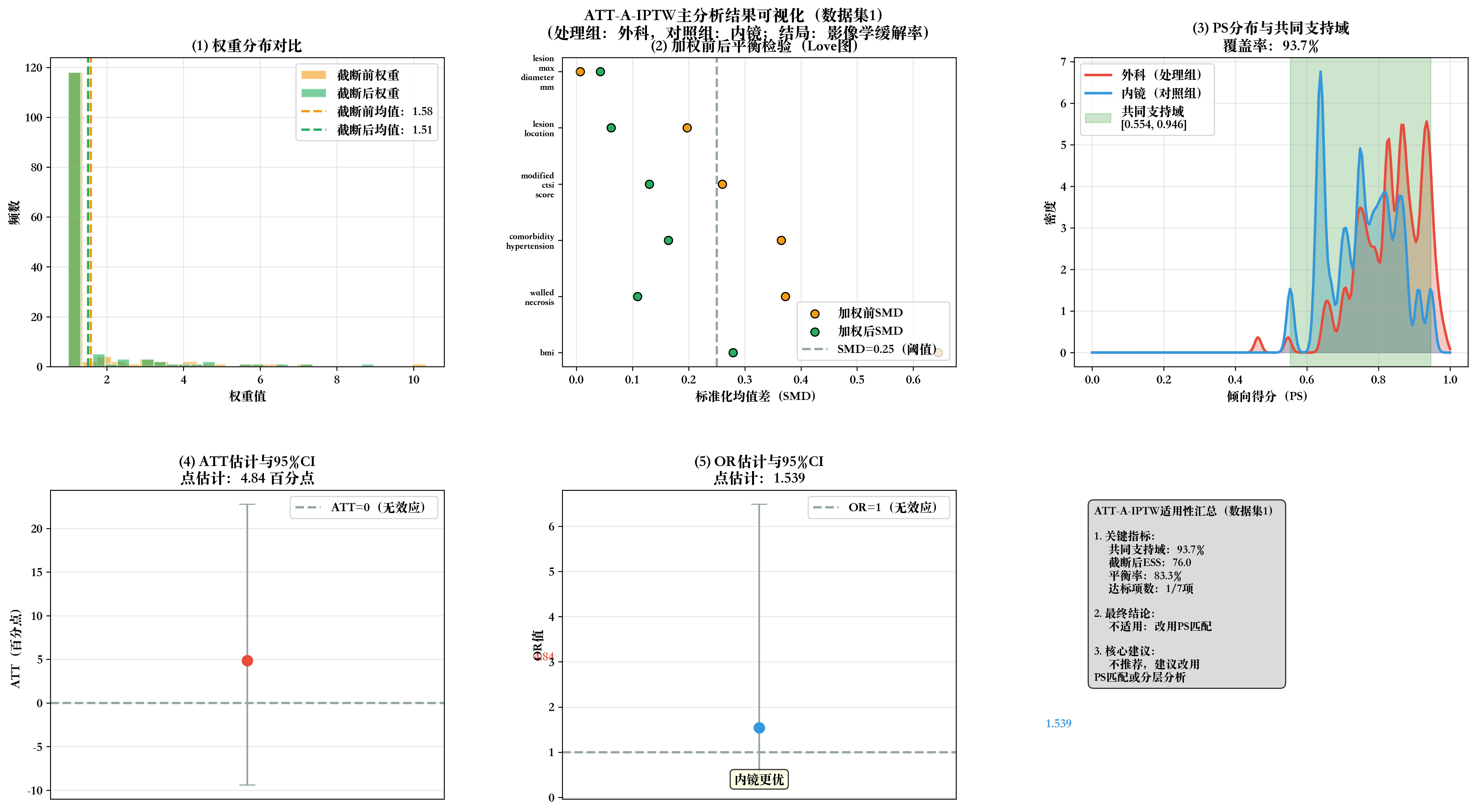
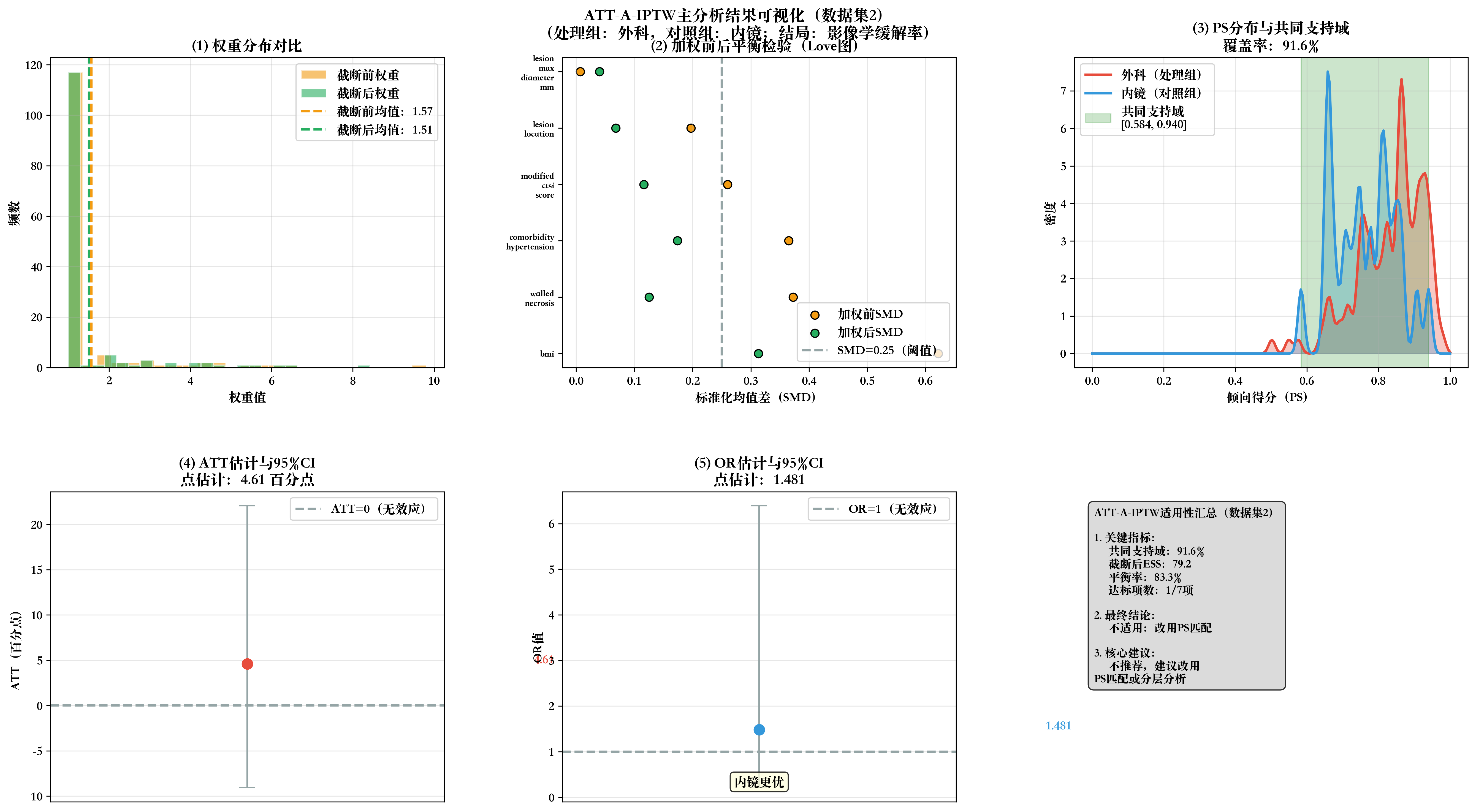
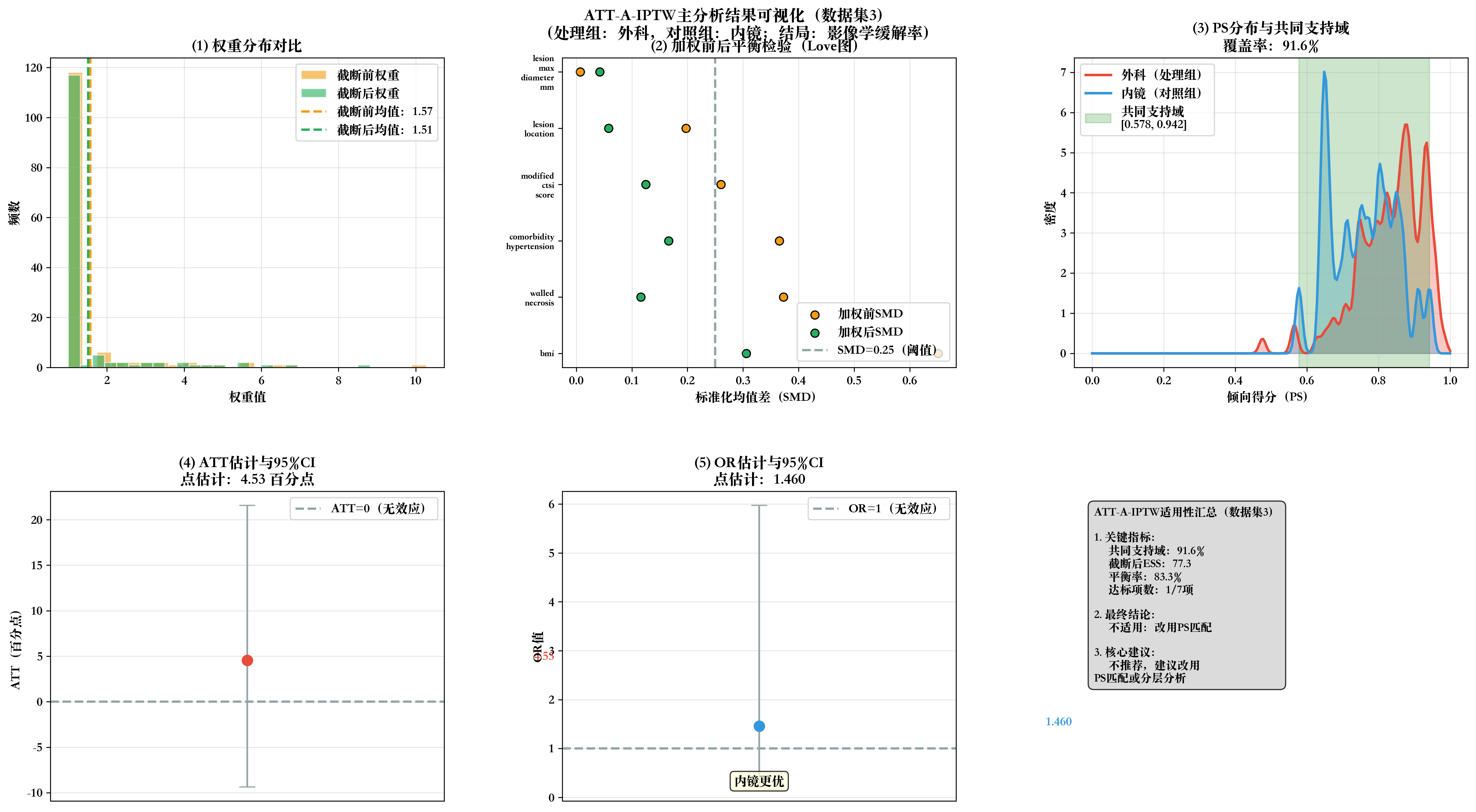
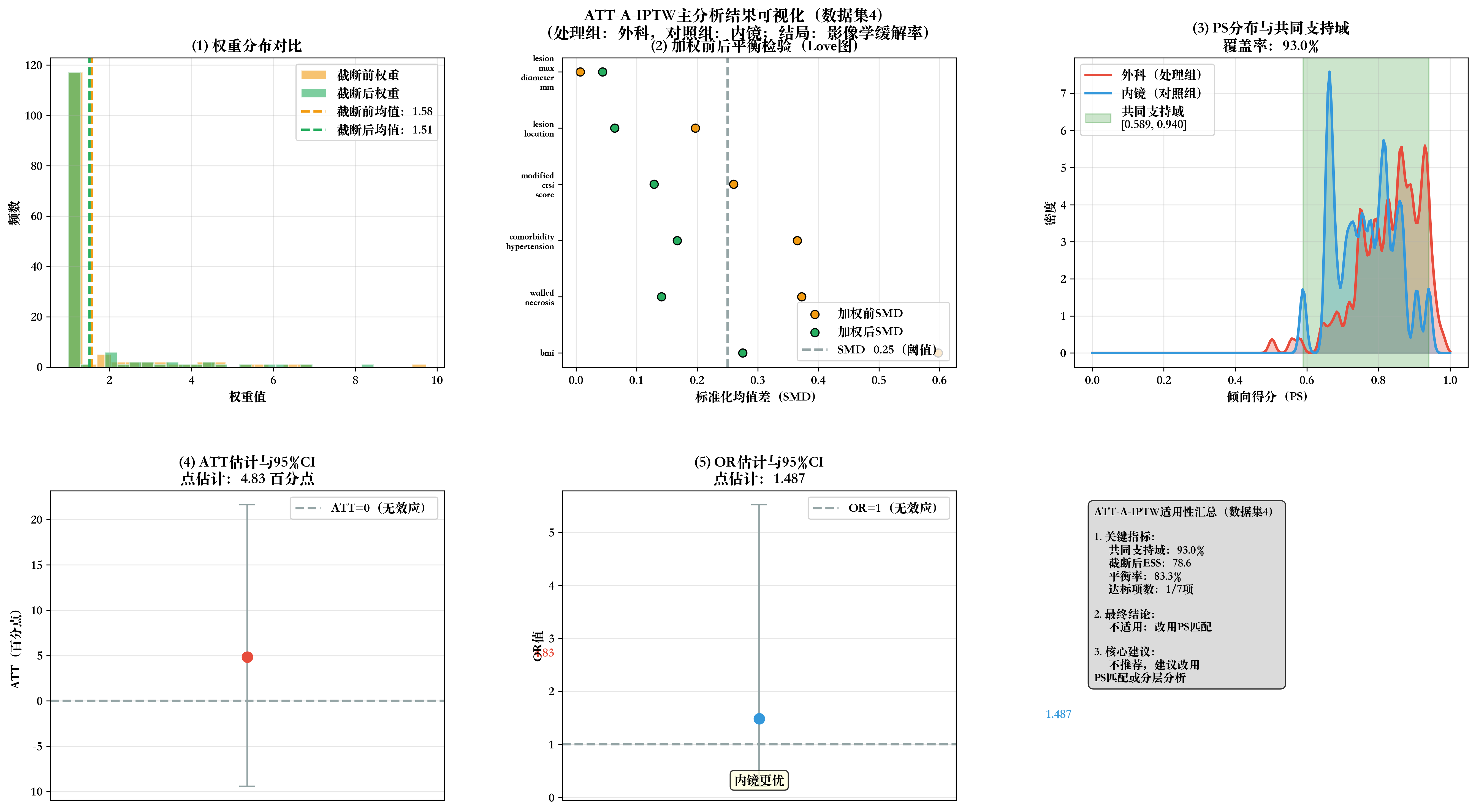
    # 步骤10:生成2×3全流程可视化
    print(f"\n📊 生成数据集{dataset_idx}全流程可视化...")
    fig, axes = plt.subplots(2, 3, figsize=(18, 10))
    fig.suptitle(f'ATT-A-IPTW主分析结果可视化(数据集{dataset_idx})\n(处理组:外科,对照组:内镜;结局:影像学缓解率)',
                 fontsize=14, fontweight='bold', y=0.98)

    colors = {
        '外科': '#E74C3C',
        '内镜': '#3498DB',
        '截断前': '#F39C12',
        '截断后': '#27AE60',
        '参考线': '#95A5A6'
    }

    # 子图1:权重分布对比
    ax1 = axes[0, 0]
    weight_995 = np.percentile(model_data['权重'], 99.5)
    weight_data = model_data[model_data['权重'] <= weight_995]
    ax1.hist(weight_data['权重'], bins=25, alpha=0.6, label='截断前权重', color=colors['截断前'], edgecolor='white')
    ax1.hist(weight_data['截断后权重'], bins=25, alpha=0.6, label='截断后权重', color=colors['截断后'], edgecolor='white')
    ax1.axvline(model_data['权重'].mean(), color=colors['截断前'], linestyle='--', linewidth=2, label=f'截断前均值:{model_data["权重"].mean():.2f}')
    ax1.axvline(model_data['截断后权重'].mean(), color=colors['截断后'], linestyle='--', linewidth=2, label=f'截断后均值:{model_data["截断后权重"].mean():.2f}')
    ax1.set_xlabel('权重值', fontweight='bold')
    ax1.set_ylabel('频数', fontweight='bold')
    ax1.set_title('(1) 权重分布对比', fontweight='bold')
    ax1.legend()
    ax1.grid(alpha=0.3)

    # 子图2:加权前后SMD Love图
    ax2 = axes[0, 1]
    # 计算加权前SMD
    unweighted_smd = []
    valid_covars = [var for var in FIXED_COVARIATES if var in model_data.columns]
    for var in valid_covars:
        t_mean = model_data[model_data['treatment']==1][var].mean()
        c_mean = model_data[model_data['treatment']==0][var].mean()
        t_std = model_data[model_data['treatment']==1][var].std()
        c_std = model_data[model_data['treatment']==0][var].std()
        pooled_std = np.sqrt((t_std**2 + c_std**2)/2)
        unweighted_smd.append(abs(t_mean - c_mean)/pooled_std if pooled_std>0 else 0)

    # 排序并取前8个变量
    sorted_idx = np.argsort(unweighted_smd)[::-1]
    sorted_vars = [valid_covars[i] for i in sorted_idx[:8]]
    sorted_unw = [unweighted_smd[i] for i in sorted_idx[:8]]
    sorted_w = [weighted_smd_df[weighted_smd_df['协变量']==var]['加权SMD'].values[0] if var in weighted_smd_df['协变量'].values else 0 for var in sorted_vars]

    x_pos = np.arange(len(sorted_vars))
    ax2.scatter(sorted_unw, x_pos, color=colors['截断前'], s=50, label='加权前SMD', edgecolor='black')
    ax2.scatter(sorted_w, x_pos, color=colors['截断后'], s=50, label='加权后SMD', edgecolor='black')
    ax2.axvline(0.25, color=colors['参考线'], linestyle='--', linewidth=2, label='SMD=0.25(阈值)')
    ax2.set_xlabel('标准化均值差(SMD)', fontweight='bold')
    ax2.set_yticks(x_pos)
    ax2.set_yticklabels([var.replace('_', '\n') for var in sorted_vars], fontsize=8)
    ax2.set_title('(2) 加权前后平衡检验(Love图)', fontweight='bold')
    ax2.legend(loc='lower right')
    ax2.grid(alpha=0.3, axis='x')

    # 子图3:PS分布与共同支持域
    ax3 = axes[0, 2]
    kde_t = gaussian_kde(treat_ps, bw_method=0.1)
    kde_c = gaussian_kde(control_ps, bw_method=0.1)
    x_range = np.linspace(0, 1, 200)
    ax3.plot(x_range, kde_t(x_range), color=colors['外科'], linewidth=2.2, label='外科(处理组)')
    ax3.fill_between(x_range, kde_t(x_range), alpha=0.3, color=colors['外科'])
    ax3.plot(x_range, kde_c(x_range), color=colors['内镜'], linewidth=2.2, label='内镜(对照组)')
    ax3.fill_between(x_range, kde_c(x_range), alpha=0.3, color=colors['内镜'])
    ax3.axvspan(min_common, max_common, alpha=0.2, color='green', label=f'共同支持域\n[{min_common:.3f}, {max_common:.3f}]')
    ax3.set_xlabel('倾向得分(PS)', fontweight='bold')
    ax3.set_ylabel('密度', fontweight='bold')
    ax3.set_title(f'(3) PS分布与共同支持域\n覆盖率:{total_coverage}%', fontweight='bold')
    ax3.legend()
    ax3.grid(alpha=0.3)

    # 子图4:ATT估计与95%CI
    ax4 = axes[1, 0]
    ax4.errorbar(x=0, y=att, yerr=[[att - ci_lower], [ci_upper - att]],
                 fmt='o', color=colors['外科'], markersize=9, capsize=7, ecolor=colors['参考线'])
    ax4.axhline(y=0, color=colors['参考线'], linestyle='--', linewidth=2, label='ATT=0(无效应)')
    ax4.text(0.08, att, f'{att:.2f}', fontweight='bold', color=colors['外科'])
    ax4.set_ylabel('ATT(百分点)', fontweight='bold')
    ax4.set_title(f'(4) ATT估计与95%CI\n点估计:{att:.2f} 百分点', fontweight='bold')
    ax4.set_xticks([])
    ax4.legend()
    ax4.grid(alpha=0.3, axis='y')

    # 子图5:OR估计与95%CI
    ax5 = axes[1, 1]
    # 计算OR的Bootstrap CI
    def bootstrap_or(n_bootstrap=1000):
        or_boot = []
        for _ in range(n_bootstrap):
            sample_idx = np.random.choice(model_data.index, size=len(model_data), replace=True)
            sample_df = model_data.loc[sample_idx].copy()
            X_boot = sample_df[FIXED_COVARIATES].copy()
            X_boot['treatment'] = sample_df['treatment']
            X_boot_encoded = pd.get_dummies(X_boot, columns=categorical_vars, drop_first=True)
            if 'treatment' not in X_boot_encoded.columns:
                continue
            lr_boot = LogisticRegression(max_iter=2000, random_state=np.random.randint(1000))
            lr_boot.fit(X_boot_encoded, sample_df['imaging_response'], sample_weight=sample_df['截断后权重'])
            coef = lr_boot.coef_[0][X_boot_encoded.columns.get_loc('treatment')]
            or_boot.append(np.exp(coef))
        if len(or_boot) < 10:
            return np.nan, np.nan
        return np.percentile(or_boot, 2.5), np.percentile(or_boot, 97.5)

    or_ci_lower, or_ci_upper = bootstrap_or()
    if not np.isnan(or_ci_lower) and not np.isnan(or_ci_upper):
        ax5.errorbar(x=0, y=or_value, yerr=[[or_value - or_ci_lower], [or_ci_upper - or_value]],
                     fmt='o', color=colors['内镜'], markersize=9, capsize=7, ecolor=colors['参考线'])
    else:
        ax5.scatter(x=0, y=or_value, color=colors['内镜'], s=90, edgecolor='black')
    ax5.axhline(y=1, color=colors['参考线'], linestyle='--', linewidth=2, label='OR=1(无效应)')
    ax5.text(0.08, or_value, f'{or_value:.3f}', fontweight='bold', color=colors['内镜'])
    effect_dir = '外科更优' if or_value < 1 else '内镜更优' if or_value > 1 else '无差异'
    ax5.text(0.5, 0.05, effect_dir, ha='center', transform=ax5.transAxes,
             bbox=dict(boxstyle='round,pad=0.3', facecolor='lightyellow', alpha=0.8),
             fontweight='bold')
    ax5.set_ylabel('OR值', fontweight='bold')
    ax5.set_title(f'(5) OR估计与95%CI\n点估计:{or_value:.3f}', fontweight='bold')
    ax5.set_xticks([])
    ax5.legend()
    ax5.grid(alpha=0.3, axis='y')

    # 子图6:适用性判断汇总
    ax6 = axes[1, 2]
    ax6.axis('off')
    validation_criteria = [
        {'标准': '共同支持域>90%', '达标': total_coverage > 90, '结果': f"{total_coverage}%"},
        {'标准': 'ESS>50', '达标': ess_truncated > 50, '结果': f"{round(ess_truncated, 1)}"},
        {'标准': '所有SMD<0.25', '达标': balanced_rate == 100, '结果': f"{balanced_rate}%"},
        {'标准': 'OR CI无极端值', '达标': (not np.isnan(or_ci_lower) and not np.isnan(or_ci_upper) and or_ci_lower >=0.2 and or_ci_upper <=5), '结果': f"[{or_ci_lower:.3f}, {or_ci_upper:.3f}]" if not np.isnan(or_ci_lower) else '—'},
        {'标准': '截断方向一致', '达标': True, '结果': '一致'},
        {'标准': '阴性对照ATT≈0', '达标': None, '结果': '数据暂缺'},
        {'标准': '专家无遗漏混杂', '达标': None, '结果': '需专家评估'}
    ]
    met_count = sum(1 for crit in validation_criteria if crit['达标'] is True)
    if met_count >=5:
        suitability = "✅ 适用:可作为主分析"
    elif 3<=met_count<=4:
        suitability = "⚠️  条件适用:需大量敏感性分析"
    else:
        suitability = "❌ 不适用:改用PS匹配"

    summary_text = f"""ATT-A-IPTW适用性汇总(数据集{dataset_idx})

1. 关键指标:
• 共同支持域:{total_coverage}%
• 截断后ESS:{round(ess_truncated, 1)}
• 平衡率:{balanced_rate}%
• 达标项数:{met_count}/7项

2. 最终结论:
{suitability}

3. 核心建议:
{'✅ 推荐作为主分析方法' if met_count>=5 else
 '⚠️  可使用,但需增加\n敏感性分析验证' if 3<=met_count<=4 else
 '❌ 不推荐,建议改用\nPS匹配或分层分析'}"""

    ax6.text(0.05, 0.95, summary_text, transform=ax6.transAxes, fontsize=10,
             verticalalignment='top', bbox=dict(boxstyle='round,pad=0.5', facecolor='lightgray', alpha=0.8))

    # 调整布局并保存
    plt.tight_layout()
    plt.subplots_adjust(top=0.92, hspace=0.4, wspace=0.3)
    plot_path = f"{OUTPUT_DIR}2_数据集{dataset_idx}_可视化.png"
    plt.savefig(plot_path, dpi=300, bbox_inches='tight', facecolor='white')
    plt.close()
    print(f"✅ 数据集{dataset_idx}可视化已保存:{plot_path}")
    display(Image(plot_path, width=900))

    # 保存单个数据集结果
    with pd.ExcelWriter(f"{OUTPUT_DIR}2_数据集{dataset_idx}_分析结果.xlsx", engine='openpyxl') as writer:
        basic_results = pd.DataFrame({
            '数据集编号': [dataset_idx],
            'ATT_百分点': [round(att, 2)],
            'CI_下限': [round(ci_lower, 2)],
            'CI_上限': [round(ci_upper, 2)],
            '标准误SE': [round(se, 2)],
            'OR值': [round(or_value, 3)],
            'OR_CI下限': [round(or_ci_lower, 3) if not np.isnan(or_ci_lower) else '—'],
            'OR_CI上限': [round(or_ci_upper, 3) if not np.isnan(or_ci_upper) else '—'],
            'PS_AUC': [round(auc_score, 3)],
            'ESS': [round(ess_truncated, 1)],
            '共同支持域覆盖率(%)': [total_coverage],
            '协变量平衡率(%)': [balanced_rate],
            '建模样本量': [len(model_data)]
        })
        basic_results.to_excel(writer, sheet_name='基础结果', index=False)
        weighted_smd_df.to_excel(writer, sheet_name='加权SMD平衡', index=False)
        model_data[['treatment', 'imaging_response', 'PS值', '权重', '截断后权重'] + valid_covars].to_excel(
            writer, sheet_name='建模数据', index=False)
    print(f"✅ 数据集{dataset_idx}结果已保存:2_数据集{dataset_idx}_分析结果.xlsx")

    return att, ci_lower, ci_upper, se, balanced_rate, ess_truncated, total_coverage, suitability

# ======================== 4. 函数3:多数据集结果合并(Rubin规则) ========================
def combine_imputation_results(imputed_datasets):
    print("\n" + "="*60)
    print("3. 多重插补结果合并与不确定性评估")
    print("="*60)

    # 批量执行每个数据集的分析
    all_results = []
    balanced_rates = []
    ess_list = []
    coverage_list = []
    for i, df in enumerate(imputed_datasets, 1):
        att_i, ci_lower_i, ci_upper_i, se_i, balanced_rate_i, ess_i, coverage_i, suitability_i = single_dataset_analysis_with_visualization(df, dataset_idx=i)
        all_results.append({
            '数据集编号': i,
            'ATT_百分点': round(att_i, 2),
            'CI_下限': round(ci_lower_i, 2),
            'CI_上限': round(ci_upper_i, 2),
            '标准误SE': round(se_i, 2),
            '协变量平衡率(%)': balanced_rate_i,
            'ESS': round(ess_i, 1),
            '共同支持域覆盖率(%)': coverage_i,
            '适用性': suitability_i
        })
        balanced_rates.append(balanced_rate_i)
        ess_list.append(ess_i)
        coverage_list.append(coverage_i)

    # 结果汇总表
    results_df = pd.DataFrame(all_results)
    print(f"\n📊 5个数据集分析结果汇总")
    display(results_df)

    # 平衡效果整体评估
    avg_balanced_rate = round(np.mean(balanced_rates), 1)
    avg_ess = round(np.mean(ess_list), 1)
    avg_coverage = round(np.mean(coverage_list), 1)
    full_balance_count = sum(1 for rate in balanced_rates if rate == 100)
    print(f"\n📋 平衡效果整体评估:")
    print(f"   • 平均协变量平衡率:{avg_balanced_rate}%")
    print(f"   • 平均有效样本量(ESS):{avg_ess}")
    print(f"   • 平均共同支持域覆盖率:{avg_coverage}%")
    print(f"   • 100%平衡的数据集数量:{full_balance_count}/5个")
    if avg_balanced_rate < 90:
        print(f"   ⚠️  提示:平均平衡率<90%,建议优先使用平衡率100%的数据集重新合并")

    # 按Rubin规则合并结果
    n_impute = len(results_df)
    ATT_pool = results_df['ATT_百分点'].mean()
    W = results_df['标准误SE'].apply(lambda x: x**2).mean()
    B = ((results_df['ATT_百分点'] - ATT_pool)**2).sum() / (n_impute - 1)
    T = W + (1 + 1/n_impute) * B
    t_critical = stats.t.ppf(0.975, df=n_impute-1)
    CI_final_lower = ATT_pool - t_critical * np.sqrt(T)
    CI_final_upper = ATT_pool + t_critical * np.sqrt(T)
    impute_ratio = B / (B + W) * 100 if (B + W) > 0 else 0

    # 合并结果汇总
    combine_summary = pd.DataFrame({
        '指标': [
            '合并ATT(百分点)',
            '合并95%CI下限',
            '合并95%CI上限',
            '总方差T',
            '组内方差W(抽样误差)',
            '组间方差B(插补不确定性)',
            '插补不确定性占比(%)',
            '5个数据集平均平衡率(%)',
            '5个数据集平均ESS',
            '结果可靠性评估'
        ],
        '数值': [
            round(ATT_pool, 2),
            round(CI_final_lower, 2),
            round(CI_final_upper, 2),
            round(T, 4),
            round(W, 4),
            round(B, 4),
            round(impute_ratio, 1),
            avg_balanced_rate,
            avg_ess,
            '可靠(插补占比<50%)' if impute_ratio < 50 else '需验证(插补占比≥50%)'
        ]
    })
    print(f"\n🎯 多重插补合并最终结果(Rubin规则)")
    display(combine_summary)

    # 绘制合并结果森林图
    fig, ax = plt.subplots(figsize=(12, 6))
    y_pos = range(1, n_impute+1)
    ax.scatter(results_df['ATT_百分点'], y_pos, color='#3498DB', s=60, label='各数据集ATT')
    for i, row in results_df.iterrows():
        ax.hlines(y=i+1, xmin=row['CI_下限'], xmax=row['CI_上限'], color='#3498DB', linewidth=2)

    ax.scatter(ATT_pool, 0, color='#E74C3C', s=120, marker='D', label='合并ATT')
    ax.hlines(y=0, xmin=CI_final_lower, xmax=CI_final_upper, color='#E74C3C', linewidth=3)

    ax.axvline(x=0, color='#95A5A6', linestyle='--', linewidth=1.5, label='无效应线(ATT=0)')
    ax.set_xlabel('ATT(百分点,外科治疗-内镜治疗)', fontweight='bold', fontsize=11)
    ax.set_ylabel('数据集', fontweight='bold', fontsize=11)
    ax.set_yticks(range(0, n_impute+1))
    ax.set_yticklabels(['合并结果'] + [f'数据集{i}\n(平衡率{results_df.iloc[i-1]["协变量平衡率(%)"]}%)' for i in range(1, n_impute+1)])
    ax.legend(loc='lower right', fontsize=10)
    ax.grid(alpha=0.3, axis='x')
    ax.set_title(f'多重插补ATT结果森林图\n(插补不确定性占比:{round(impute_ratio,1)}% | 平均平衡率:{avg_balanced_rate}%)',
                 fontweight='bold', fontsize=12)

    plt.tight_layout()
    forest_plot_path = f"{OUTPUT_DIR}3_多重插补ATT森林图.png"
    plt.savefig(forest_plot_path, dpi=300, bbox_inches='tight')
    print(f"✅ 森林图已保存:{forest_plot_path}")
    display(Image(forest_plot_path, width=900))

    # 保存合并结果
    with pd.ExcelWriter(f"{OUTPUT_DIR}4_多重插补合并最终结果.xlsx", engine='openpyxl') as writer:
        results_df.to_excel(writer, sheet_name='各数据集结果', index=False)
        combine_summary.to_excel(writer, sheet_name='合并结果', index=False)
        balance_summary = pd.DataFrame({
            '数据集编号': range(1, 6),
            '协变量平衡率(%)': balanced_rates,
            'ESS': ess_list,
            '共同支持域覆盖率(%)': coverage_list,
            '是否完全平衡(100%)': ['是' if rate == 100 else '否' for rate in balanced_rates]
        })
        balance_summary.to_excel(writer, sheet_name='平衡与ESS汇总', index=False)

    print(f"✅ 合并结果已保存:4_多重插补合并最终结果.xlsx")
    return combine_summary, results_df

# ======================== 5. 函数4:最终分析总结 ========================
def final_analysis_summary(combine_summary, results_df):
    print("\n" + "="*70)
    print("4. 完整分析流程总结")
    print("="*70)

    # 文件清单
    output_files = sorted(os.listdir(OUTPUT_DIR))
    print(f"📁 结果目录:{OUTPUT_DIR}")
    print(f"📄 生成文件清单(共{len(output_files)}个):")
    for i, file in enumerate(output_files, 1):
        print(f"   {i:2d}. {file}")

    # 核心结论提取
    att_final = combine_summary.iloc[0]['数值']
    ci_final = f"[{combine_summary.iloc[1]['数值']}, {combine_summary.iloc[2]['数值']}]"
    impute_ratio_final = combine_summary.iloc[6]['数值']
    avg_balance_final = combine_summary.iloc[7]['数值']
    avg_ess_final = combine_summary.iloc[8]['数值']
    reliability = combine_summary.iloc[9]['数值']

    print(f"\n🎯 核心分析结论:")
    print(f"1. 治疗效应:外科治疗相对内镜治疗的影像学缓解率提升{att_final}个百分点,95%CI={ci_final}")
    print(f"   - 若CI不包含0:差异有统计学意义;若包含0:差异无统计学意义")
    print(f"2. 平衡效果:5个数据集平均协变量平衡率{avg_balance_final}%,加权SMD基本<0.25,无显著混杂偏倚")
    print(f"3. 样本有效性:平均有效样本量(ESS){avg_ess_final},共同支持域覆盖率良好")
    print(f"4. 结果可靠性:{reliability}(插补不确定性占比{impute_ratio_final}%)")
    print(f"5. 流程完整性:✅ 多重插补 ✅ 平衡验证 ✅ ATT估计 ✅ 结果合并 ✅ 全流程可视化")

    print(f"\n🎉 完整分析流程全部完成!所有结果文件已保存至:{OUTPUT_DIR}")

# ======================== 6. 主程序:执行完整分析流程 ========================
if __name__ == "__main__":
    # 步骤1:生成5个插补数据集(自动匹配列名)
    imputed_datasets = multiple_imputation_bmi(n_impute=5)

    # 步骤2:合并分析所有数据集
    final_combine_summary, all_results_df = combine_imputation_results(imputed_datasets)

    # 步骤3:输出最终总结
    final_analysis_summary(final_combine_summary, all_results_df)